Founder Introduction
What We Are Building
We are engineering a scalable, multi-model robotic platform specifically designed to autonomously manage roadside litter. Our solution is a fleet of compact, all-terrain robots, no larger than a shopping cart, built to navigate the complex and unstructured environments where trash accumulates: areas inaccessible to traditional street sweepers.
Core Technology: AI-Powered Collection
Each robot combines our advanced AI vision system with a high-efficiency collection mechanism. Dual rotational sweepers actively channel debris into a "dustpan" base, where a conveyor belt system transports and stores the litter in an onboard component.
Strategic Fleet: A Two-Model Solution
We are not building a single robot; we are deploying a complete system. Our fleet is bifurcated to solve two distinct operational challenges:
The "Ranger" Model
Long-Distance Focus
Our flagship autonomous solution for highways and long-distance routes. This model is engineered for maximum self-sufficiency, featuring integrated solar panels to extend operational range and dramatically reduce retrieval logistics.
The "Urban" Model
Short-Distance Endurance
Designed for high-density municipal routes. This model maximizes uptime through a network of "Streetsweep Hubs," where it can autonomously exchange batteries and deposit collected trash.
Engineering for the Environment
Our design is purpose-built for the realities of the roadside. While initial chassis prototyping is being conducted with wheels, the production platform is designed for all-terrain treads. This is a critical differentiator, enabling our robots to navigate the grass, gravel, slopes, and uneven terrain that wheeled competitors cannot. The platform is modular, allowing us to continuously integrate engineering advancements and adapt to new challenges.
Tech Stack
Our tech stack is purpose-built for high-performance, autonomous operation and rapid, iterative development.
Core AI: Multi-Model Vision System
We leverage powerful, pre-trained models and develop proprietary solutions:
Our key differentiator is the proprietary model we're developing in-house, trained on custom datasets to identify hard-to-classify and regional trash items that standard models miss.
Onboard Architecture
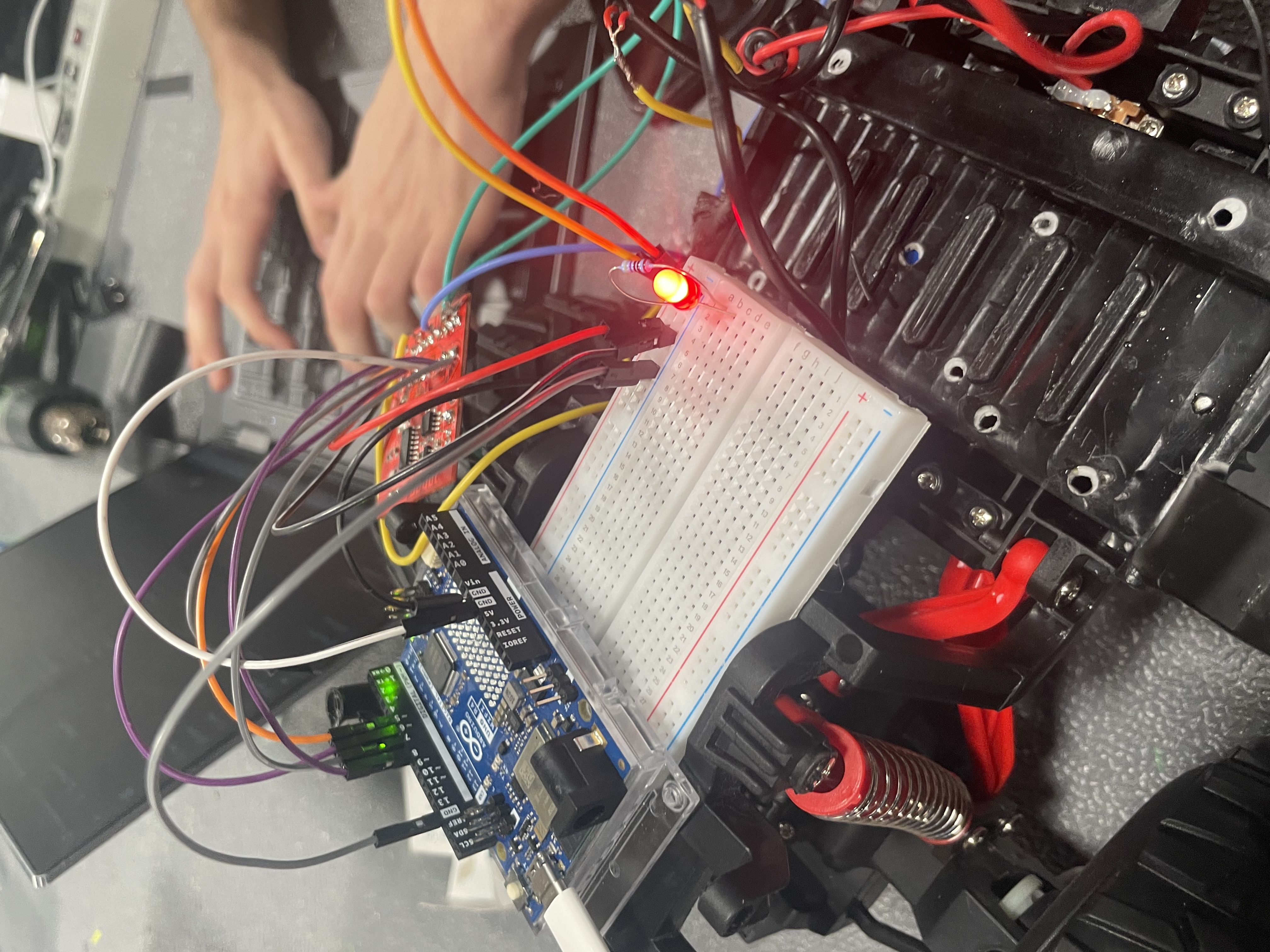
Raspberry Pi
High-performance "brain" running Python to manage autonomous navigation, sensor fusion, and AI vision model execution.
Arduino
Reliable, real-time, low-level control of physical hardware including drive motors, sensors, and sweeping mechanisms.
Development Tools
Our programming is augmented by advanced AI coding assistants, including Cursor (leveraging GPT-5 and Claude Sonnet 4.5), allowing us to rapidly prototype, debug, and deploy new features.
Why This Idea?
The Problem
Roadside trash is a multi-billion dollar operational liability. Current methods (manual labor and large vehicles) are expensive, slow, and dangerous.
The Opportunity
The autonomous cleaning market is validated and growing, but current solutions focus on large street sweepers for urban environments. The agile, all-terrain roadside cleanup market remains completely underserved.
Our Solution
A fleet of small, agile, tread-based robots is fundamentally more effective and scalable than large street sweepers. Combined with our AI vision system, solar power, and battery-swap hubs, we're built for a problem our competitors are ignoring.
Competitors & Our Advantage
Tier 1: Status Quo
Manual labor crews and large, human-operated sweeper trucks. Governments spend over $1.3B annually on this.
Tier 2: Bucher Municipal
Market leader with autonomous electric street sweepers (CityCat V20e) deployed in cities like Singapore. $200,000+ per vehicle.
Tier 3: Niche Robotics
BeBot (beach cleaning, ~$80k) and MARBLE (trash bin emptying) validate the market but focus on different, smaller markets.
Business Model & Revenue
Phase 1: Pilot Programs (Year 1-2)
1-3 paid pilot programs to validate technology with real customers.
Phase 2: Early Growth (Year 3-5)
Convert pilots to full RaaS contracts and sign 5-10 new municipalities.
Example: 10 cities × 5 robots × $3,000/mo =
Projected: $1M - $10M ARR
Phase 3: Scale-Up (Year 5+)
Capturing just 1% of the $1.47B autonomous sweeper market.
Projected: $10M - $50M+ ARR
Demo & Media
Product Demo
Links
Technical Specifications
| Component | Specification | Notes |
|---|---|---|
| Size | Shopping cart sized | Compact, all-terrain platform |
| Locomotion | All-terrain treads | Production model (wheels for prototyping) |
| Collection Mechanism | Dual rotational sweepers + conveyor belt | Channels debris into onboard storage |
| Processing Unit | Raspberry Pi | Python-based navigation and AI execution |
| Control Unit | Arduino | Real-time hardware control |
| AI Models | YOLOv11n, TACO, Custom proprietary model | Multi-model vision system |
| Ranger Model | Solar panels integrated | Long-distance, self-sufficient operation |
| Urban Model | Battery swap hubs | High-density municipal routes |